
Why Movement Matters In Floral Design


A beautiful floral arrangement can be admired in a photograph.
A truly successful floral design should be experienced in a room.
For Jacqueline Elfe of Stellar Style Events, one of the most important differences between simply placing flowers in a space and creating an environment with flowers is movement.
Flowers should never feel as though they have simply been set down in a series of decorative moments. They should guide the eye, create rhythm, respond to architecture and contribute to the way guests experience a celebration.
That sense of movement is one of the details that can make an event feel effortless.
Floral Design Is About More Than the Flowers
When designing an event, it is tempting to begin with the obvious question:
Which flowers should we use?
But the more important questions often come first.
How large is the room?
Where will guests enter?
What will they see first?
Where will they naturally look?
How does the light move through the space?
What architectural elements already exist?
Where does the eye need a moment of emphasis—and where should the design remain quiet?
Flowers are only one part of the answer.
The larger goal is to create a visual experience in which each floral element has a relationship to everything around it.
This is why floral design becomes especially interesting when it moves beyond individual arrangements and begins to interact with the environment.
Creating a Visual Rhythm
Think about walking through a beautifully designed room.
Your eye does not remain fixed on one object. It moves.
Perhaps you notice an entrance installation first. Then your attention travels toward the ceremony space. From there, you discover the tables, the lighting, the surrounding architecture and smaller floral details.
Good design gives the eye somewhere to go.
This can be achieved through differences in:
Height
Scale
Shape
Texture
Density
Placement
Color
Negative space
A room filled with flowers is not necessarily more beautifully designed than a room with fewer flowers.
In fact, restraint can often make the individual floral moments more powerful.
Movement Can Come From Scale
One of the most effective ways to create movement is through scale.
A floral design does not have to maintain the same height or volume throughout an event.
A low arrangement can create intimacy at a dining table.
A taller installation can draw attention upward.
A larger architectural floral moment can establish a focal point.
Smaller details can then create connections between these larger elements.
Together, they create a visual rhythm.
The result feels intentional rather than repetitive.
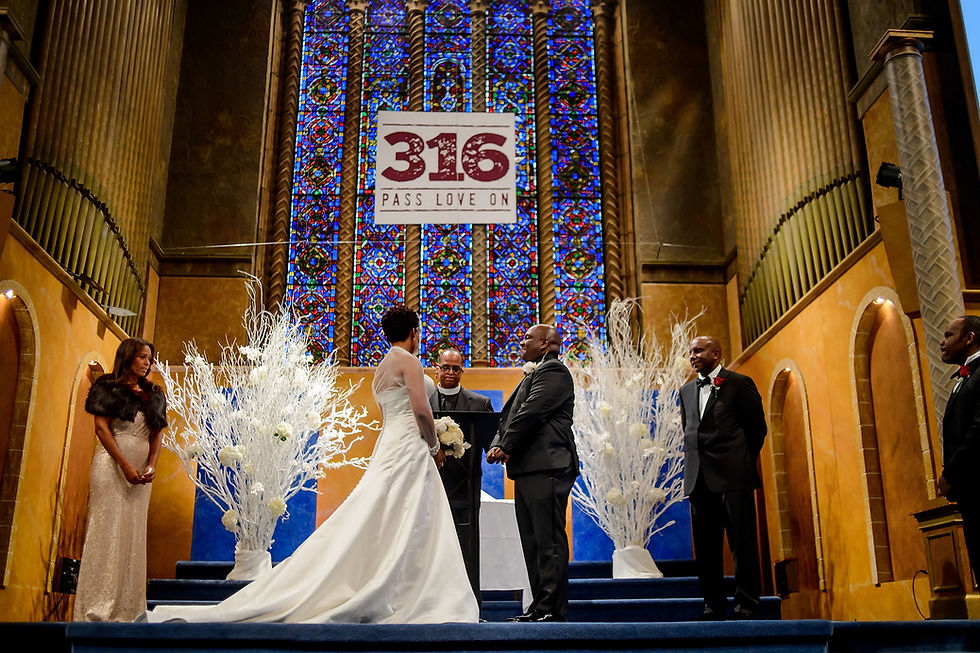
Architecture Is Part of the Composition
Every venue has its own personality.
Architecture, scale, light, existing color and the way guests move through the space all influence the design approach.
This is particularly important when working with flowers.
A floral design should not compete with beautiful architecture simply because there is space to fill.
Instead, the flowers should understand the room.
Sometimes that means emphasizing height.
Sometimes it means creating softness against a more structured environment.
Sometimes the strongest design decision is knowing what to leave untouched.
The venue is not a blank canvas.
It is already part of the story.
The Importance of Negative Space
Luxury design often depends as much on what is absent as what is present.
Negative space allows individual elements to breathe.
When every surface is competing for attention, the eye becomes overwhelmed. When there is variation between floral moments and open space, each element can have greater impact.
This is particularly important for weddings and celebrations where the flowers need to coexist with:
Architecture
Tablescapes
Lighting
Rentals
Stationery
Fashion
Entertainment
The movement of guests
The flowers are not the entire experience.
They are part of a larger environment.
Designing for the Guest Experience
Ultimately, movement is not just visual.
It is experiential.
Guests should be able to move through a celebration and discover the design gradually.
An entrance might establish the mood.
A ceremony installation might create the emotional focal point.
Reception flowers might become more intimate and detailed.
A statement installation might surprise guests later in the evening.
Each moment can have its own character while still belonging to the same visual language.
This is where event design becomes more than decoration.
It becomes storytelling.
Jacqueline's Approach
For Jacqueline, the objective is not simply to add more flowers.
It is to understand what the room needs.
Sometimes that means abundance.
Sometimes it means restraint.
Sometimes it means creating one extraordinary floral statement rather than filling every available surface.
The most successful designs are often the ones where every decision feels connected.
The flowers, architecture, color, scale and guest experience all speak to one another.
That is where movement becomes meaningful.
The Final Detail
When guests walk into a beautifully designed celebration, they may never consciously identify why the room feels balanced.
They simply feel it.
Their eye moves naturally.
The space feels considered.
Nothing feels accidental.
That is the quiet power of movement in floral design.
Flowers can decorate a room. Thoughtful floral design can transform how the room is experienced.


Comments